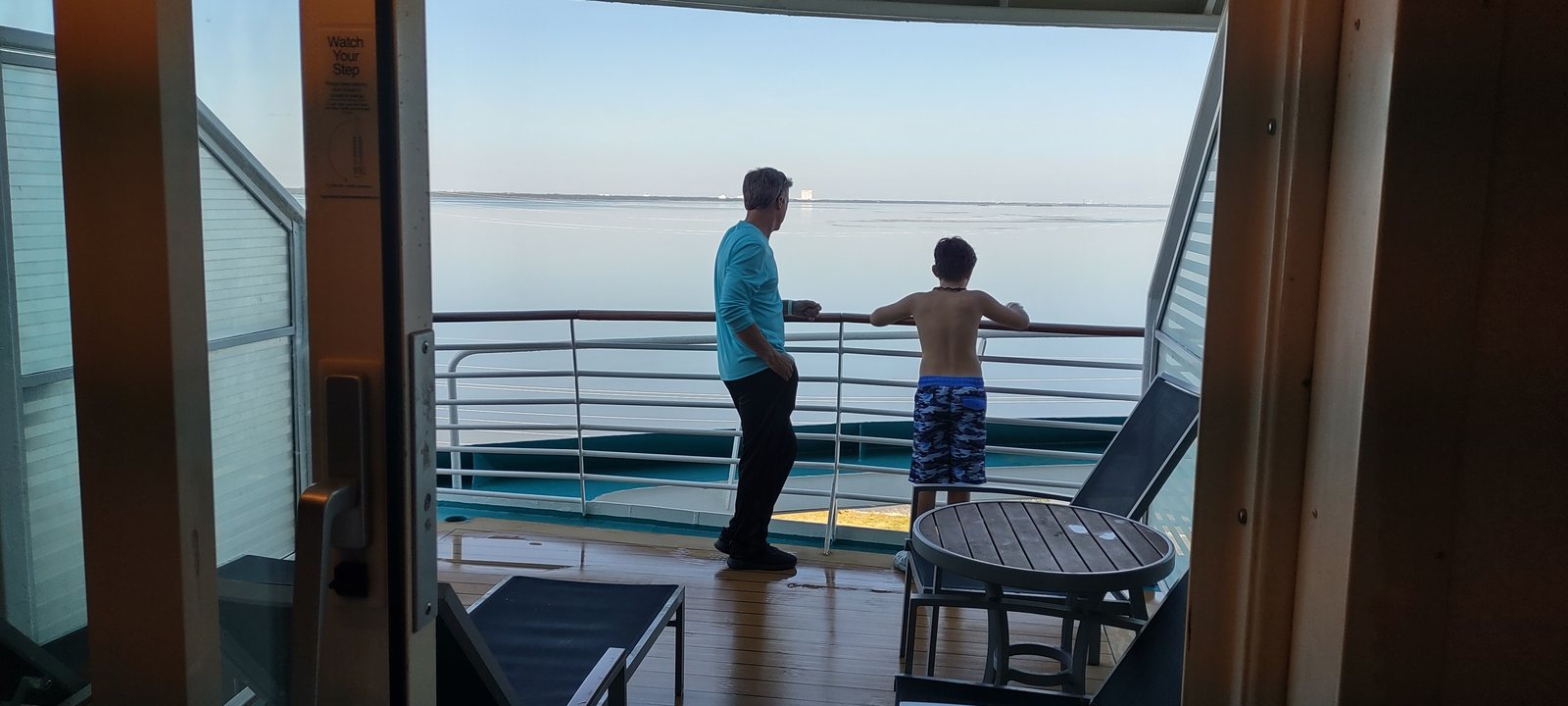
A grandchild sailing without their parents needs a notarised consent form signed by their legal guardian. Royal Caribbean and Celebrity both publish this requirement for any guest aged 17 or under. On a closed-loop cruise a US citizen child under 16 may travel on a birth certificate, but the form is separate and still required.
Taking a grandchild on a cruise is one of the loveliest things you can do. It is also the thing most likely to end in a conversation at the check-in desk that you cannot win, because two separate sets of rules apply and neither is optional.
One set is federal. The other is the cruise line's. You need both.
Rule one: the notarised consent form
Royal Caribbean states it plainly: "When a minor (age 17 and under) travels without their legal guardian, an accompanying adult must present a notarized form signed by the child's guardian." Celebrity publishes word-for-word the same requirement.
Royal Caribbean publishes the actual form, titled "Consent for Minor (0-17) Child to Travel Without Parent/Legal Guardian." It must be sworn and signed before a solicitor, commissioner for oaths, notary public or justice of the peace — and it does three things that matter enormously if anything goes wrong:
- Authorises you to supervise the minor while onboard
- Authorises you to sign waivers so the child can join activities
- Authorises you to consent to necessary, routine or emergency medical treatment
That third line is the one to think about. Without it, a doctor at sea has a child in front of them and nobody present who can legally consent to treatment. Get the form, get it notarised, and put it with the passports.
Rule two: what counts as the child's ID
This is where the closed-loop cruise exception helps you, and it is written into federal regulation rather than a cruise line policy.
A closed-loop cruise is one that begins and ends at the same US port. For those, the regulations permit a US citizen to present a government-issued photo ID together with an original or a copy of their birth certificate instead of a passport, when travelling entirely within the Western Hemisphere.
For children, CBP's own fact sheet is more generous still: "U.S. and Canadian citizen children under the age of 16 (or under 19, if traveling with a school, religious group, or other youth group) need only present a birth certificate or other proof of citizenship," and that birth certificate may be "original, photocopy, or certified copy."
The cruise lines narrow it. Royal Caribbean requires US birth certificates to be "the original or an official document issued by the government" — not a hospital souvenir certificate with tiny footprints on it, which is what a surprising number of families turn up with. Celebrity asks for an "Original U.S. State Certified Birth Certificate or a certified copy." Both publish that guests aged 15 and under do not need photo ID, just the birth certificate.
Rule three: the one nobody thinks about until the desk asks
Proof of relationship. The State Department's advice is one sentence and it is the sentence to act on: "Always bring a copy of each child's birth certificate or other evidence of your legal relationship to each child."
If your surname differs from your grandchild's — which it very often does — the birth certificate is what connects you, usually via your own child's name on it. If your own name has changed through marriage, take the marriage certificate too. It sounds like overkill until you are standing at a counter explaining why the child with you has a different last name.
What the State Department says about the letter
Beyond the cruise line's form, the State Department publishes that "when the child is traveling alone or with someone who is not a parent or legal guardian, some countries require that parents or legal guardians provide a notarized, written permission letter." The United States itself does not require it — other countries do, and your ship is visiting them.
USAGov publishes suggested wording, which is refreshingly simple: "I acknowledge that my child is traveling outside the country with [the name of the adult] with my permission." They add that it is preferred in English and notarised, and that where the child travels with a guardian, both parents should sign.
The folder I would put together
- The cruise line's notarised consent form, signed by both parents, including the medical consent clause.
- The child's certified birth certificate — government-issued, not the decorative one.
- The child's passport if they have one. Belt and braces, and it solves the fly-home problem.
- Your own photo ID and passport.
- Anything that proves the chain of relationship where surnames differ, including your marriage certificate.
- A page of contact numbers and the child's medical details — allergies, medications, the paediatrician, both parents' mobiles.
- Copies of everything, kept separately from the originals.
Do the notarising two or three weeks out, not the week before. Notaries have opening hours and parents have jobs.
One programme worth understanding
The State Department runs the Children's Passport Issuance Alert Program, a free service that alerts a parent or guardian when someone applies for a US passport for their child. It exists to help prevent international parental child abduction, and it is only for US citizens under 18.
It is worth a grandparent knowing this exists, because if a grandchild is enrolled and you go to apply for a passport for them, it generates an alert. That is the system working as designed. The Department is also clear about the limits: it "cannot block the issuance of foreign passports" and "cannot prevent a child from traveling internationally."
And if the grandchild needs a passport in the first place: both parents or guardians must be present with a child under 16, or the absent parent must sign Form DS-3053 before a notary. Under-16 passports are valid five years and cannot be renewed by mail.
Questions I get asked
Do I really need the form if it is just a Bahamas cruise?
Royal Caribbean and Celebrity both publish it as a requirement for any minor sailing without their guardian. It is not itinerary-dependent.
Is a photocopy of the birth certificate enough?
CBP's fact sheet permits a photocopy for a qualifying child. The cruise lines ask for the original or a certified copy. Meet the stricter one.
What if the parents are divorced?
The State Department publishes that some countries require a notarised letter from the other parent, or proof of sole legal custody. Take the custody documents.
Can the child be in their own cabin?
Celebrity publishes that children must be in the same or an adjacent stateroom to a parent or guardian, and nobody under 21 is booked in a stateroom without an adult 21 or older.
What if we get the paperwork wrong?
You are refused boarding, and that is not a refundable situation. This is a folder worth assembling early.
Document rules change and vary by itinerary, citizenship and cruise line. Confirm the current requirements with your own cruise line and with CBP before you travel. This is information, not legal advice.
Where these facts come from
- CBP, Western Hemisphere Travel Initiative fact sheet (PDF)
- 22 CFR 53.2, passport exceptions (eCFR)
- 8 CFR 235.1, documentary requirements (eCFR)
- US State Department, children travelling abroad
- US State Department, Children's Passport Issuance Alert Program
- US State Department, passports for children under 16
- USAGov, travel documents for children
- Royal Caribbean, consent form for a minor travelling without a guardian (PDF)
- Royal Caribbean, travel documents
- Celebrity Cruises, travel documents
Ports change their rules and their prices. Check the official pages above before you sail.
Stairs, gangways, tenders, long piers, a cane on bad days. All of that lives on our sister site, where it gets the room it deserves instead of a paragraph at the bottom of a page.
About the "I" on this page. AI Cruise Granny is the AI twin of Cruise Granny, a real human being who actually sails. Every experience written here in the first person is hers. The AI twin is what writes it up, checks the facts against official sources and keeps it current. We tell you that openly on every page, because you should know who is talking to you. More about how this works.