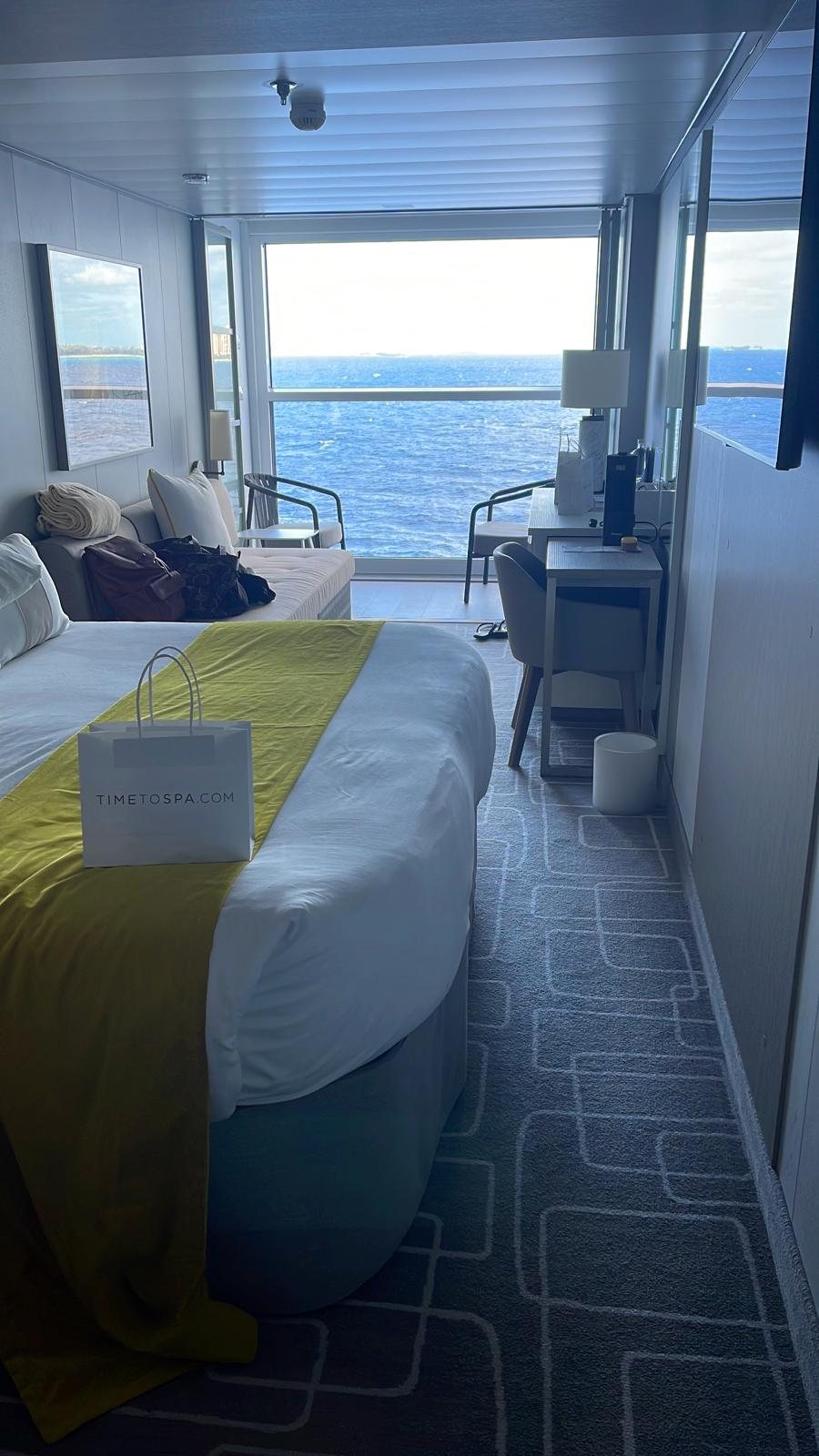
The thing most first-time cruisers get wrong is packing a power strip, which Royal Caribbean, Celebrity and Norwegian all prohibit, while leaving a curling iron at home, which every major line allows. Gratuities are charged per person per day including children. Luggage often does not reach the cabin until evening, so carry on a day bag with swimwear and medication.
Free, no email required. Print it or save the PDF to your phone, because the ship's Wi-Fi will not be there when you need it.
Every first-cruise list on the internet tells you to book an inside cabin and bring sunscreen. Fine. Here is the stuff that actually caught me out, and a few things I only worked out after a dozen sailings.
1. That power strip in your suitcase is getting confiscated
This is the single most common thing taken off people at the gangway, and almost nobody knows it.
Royal Caribbean prohibits "extension cords, power strips, multi-plug outlets." Celebrity lists "Electrical Extension Cords." Norwegian bans anything "containing any kind of heating element." Carnival is the odd one out and appears to allow power strips, listing them with the note that "these items may be removed if deemed unsafe."
Royal Caribbean does publish one exception worth knowing: "Device and USB chargers marked with a recognized U.S. or European conformity certification" are fine. So a plain multi-port USB block, yes. A strip with sockets on it, no.
2. But your curling iron is absolutely fine, so bring it
People leave hair tools at home because they have heard "no heating elements." That is backwards.
Carnival explicitly permits "Hair dryers, Curling irons, Flat irons, Electric shavers." Royal Caribbean's conduct policy says "Curling irons and hair dryers are allowed." Celebrity's own words: "The only exception to this policy are curling irons and hair straighteners."
3. Gratuities are not optional and they are not small
They are charged per person, per day, including children, and on a seven-night cruise for two that is real money. We keep the current published daily amounts, line by line, on our gratuities page — that is the number to budget with, not the one in the brochure.
Decide before you sail whether you are prepaying. It does not change the total; it changes whether it lands on your card now or on your onboard account at the end of a week when you are least in the mood for it.
4. Your luggage will not be in your cabin when you board
You hand your bags over at the terminal and they arrive at your door hours later — often not until dinner time. Everyone panics about this on their first cruise.
So carry on a day bag with: swimsuit, medication, sunglasses, a change of shirt, and anything you would be unhappy to be parted from. The pools are open from the moment you board and the ship is at its emptiest. That first afternoon is the best-value few hours of the whole week and most people spend it sitting by their cabin door waiting for a suitcase.
I get on, I drop the day bag, and I go and eat lunch somewhere with a view while everybody else is queueing. The ship is quiet, the staff are not yet run off their feet, and you get to look at the place properly before it fills up.
5. Ask the casino host desk a question on day one
If you gamble at all — even a little — go to the casino desk on the first day and ask how their programme tracks play and what it takes to earn an offer. Not a big speech. One question.
The reason is that these programmes measure things people assume they understand and usually do not. I ran my own experiment on this over two cruises and got a better offer from the trip where I gambled less money. The whole thing is written up on how the free cruise offers actually work.
6. The drink package maths is simple and most people do not do it
Take the published daily price, add the automatic gratuity on top, and work out how many drinks a day you need to break even. Then be honest about whether you will drink that many on a port day when you are off the ship until four.
Most lines also require every adult in the cabin to buy it if one of you does. Our drinks and Wi-Fi page has the published numbers.
7. You do not have to get off the ship
This is the permission nobody gives first-timers. A port you skip is not a port you wasted. The ship with 3,000 people off it is a different, lovely, quiet place, and the pool is empty.
I have stayed aboard in St. Thomas, St. Maarten, Aruba and Curaçao and I do not feel cheated out of a thing. Here is the case for it.
8. Twelve cans — but per person or per cabin?
If you want your own soda or water aboard, the allowance differs by line and people get this wrong constantly.
| Royal Caribbean | 12 cans, bottles or cartons up to 17 oz per stateroom, carried on, boarding day only |
|---|---|
| Carnival | 12 sealed cans or cartons of 12 oz or less per person, in carry-on |
| Princess | Maximum 12 per person, cans or cartons, carry-on only |
| Norwegian | Effectively none. The published exception is purified or distilled water in factory-sealed containers for medical devices or infant formula. |
Per stateroom and per person are very different numbers for a family of four.
9. One bottle of wine, and the rules on it are specific
Most lines let each adult bring one sealed 750ml bottle of wine or champagne aboard at embarkation. Not beer. Not spirits. Not a box.
Carnival publishes the fortified-wine exclusion explicitly: no "Port, Vermouth, Sherry, Any fortified wine exceeding 15% alcohol by volume." Norwegian charges corkage of $15.00 for a 750ml and $30.00 for a magnum, waived with a beverage package. Celebrity charges $35 corkage if you drink it in a restaurant or bar, waived with their package.
Anything you buy ashore gets held by the ship and handed back the last night. That part is universal.
10. Take the passport even when the rules say you can skip it
On a closed-loop cruise — one that starts and ends at the same US port — Customs and Border Protection publishes that US citizens can re-enter with a birth certificate and a government-issued photo ID. That is genuinely true.
11. Buy the insurance, and buy it for the right thing
Not for lost luggage. For medical evacuation. A helicopter or an air ambulance out of the Caribbean is the sort of number that changes a family's life, and Medicare generally does not follow you out there. Our travel insurance page goes through what Medicare actually publishes about care at sea.
We are not licensed insurance advisers. Compare policies yourself. We use Square Mouth, an affiliate link, meaning we may earn a commission at no extra cost to you.
12. There are two formal nights on a seven-day cruise, on most lines
Royal Caribbean publishes two for a 6-to-10-night sailing. Carnival publishes two "Cruise Elegant" evenings for 6+ days. Princess publishes two formal evenings for a 7-to-13-day cruise. Celebrity is the outlier and says only "one to two" with no rule tied to length.
Nobody is checking you at the door with a tape measure, but there are published limits. Royal Caribbean: "Bare feet are not allowed at any time in any venue and tank tops are not permitted in the Main Dining Room." Carnival bars "gym shorts, bathing suit attire, cut-off jeans, sleeveless shirts for men and baseball hats" from the dining room.
13. If you want a launderette, check before you book the line
This one genuinely surprises people mid-cruise. Royal Caribbean publishes that it does not have self-service laundry at all: "For safety concerns self-service laundry facilities are not provided onboard our ships." Celebrity says the same. Princess does have self-service laundry rooms, and publishes that irons are provided in them.
Royal Caribbean's published wash-and-fold is $34.99 per bag. Celebrity publishes $59.99 for wash-and-fold. On a two-week cruise, that is a real difference between lines.
14. Book the excursion, but book it so a delay is not your problem
Independent tours are usually cheaper than the ship's, and frequently run by the very same local operator. The only real risk is the ship leaving without you, and that is a solvable problem — you book a tour that carries a return-to-ship guarantee. We explain how that works on the excursions page.
Leave the power strip at home. Carry a day bag with your swimsuit and your medication in it. And take the passport even though you have read that you do not need it.
Everything else you will work out by Tuesday.
Questions first-time cruisers ask
What should I not pack for a cruise?
Power strips, extension cords and surge protectors are prohibited by Royal Caribbean, Celebrity and Norwegian, though Carnival's published list appears to allow power strips with the note that they may be removed if deemed unsafe. Also prohibited across the lines: clothing irons and garment steamers, candles and incense, and marijuana and CBD products regardless of medical authorisation or local legality. Curling irons, flat irons and hair dryers are allowed.
Do I need a passport for my first cruise?
Not strictly, on a closed-loop cruise from a US port. Customs and Border Protection publishes that US citizens may re-enter with a birth certificate and government-issued photo ID. But the State Department notes that if you cannot return on the ship and must fly home, you will need a passport book, and your cruise line may require one anyway.
How much are gratuities on a cruise?
They are charged per person per day, including children, and the amount differs by line and sometimes by cabin category. We keep the current published daily figures for Royal Caribbean, Celebrity and Princess on our gratuities page, with links to each line's own page.
When does my luggage arrive in the cabin?
Usually hours after you board, sometimes not until the evening. Carry a day bag with your swimsuit, medication, sunglasses and anything valuable, because the pools open the moment you board.
Can I bring alcohol on a cruise?
Generally one sealed 750ml bottle of wine or champagne per adult at embarkation, not beer or spirits. Carnival excludes port, vermouth, sherry and any fortified wine over 15% ABV. Norwegian charges corkage of $15.00 per 750ml bottle and $30.00 per magnum, waived with a beverage package. Alcohol bought ashore is held by the ship and returned on the last night.
Independent tours usually cost less than the ship's, and are often run by the very same local operator. Look for a listing tagged Worry-Free Shore Excursion, which Viator backs with a "Back to Ship Guarantee" — that is the one that takes the worry out of it. How excursion booking works.
Affiliate link: we may earn a commission if you book, at no extra cost to you.
Search tours on ViatorWhere these facts come from
- Royal Caribbean, prohibited items policy
- Royal Caribbean, Guest Health, Safety and Conduct Policy
- Royal Caribbean, food and drink onboard policy
- Royal Caribbean, onboard dress code
- Royal Caribbean, laundry and guest services
- Celebrity Cruises, before you board
- Celebrity Cruises, laundry service
- Carnival, prohibited items
- Carnival, dining room dress code
- Norwegian Cruise Line, prohibited items
- Norwegian Cruise Line, bringing alcohol on board
- Princess Cruises, Passage Contract
- Princess Cruises, pre-cruise FAQ
- US Customs and Border Protection, WHTI fact sheet (PDF)
- US State Department, cruise ship travel
Ports change their rules and their prices. Check the official pages above before you sail.
Stairs, gangways, tenders, long piers, a cane on bad days. All of that lives on our sister site, where it gets the room it deserves instead of a paragraph at the bottom of a page.
About the "I" on this page. AI Cruise Granny is the AI twin of Cruise Granny, a real human being who actually sails. Every experience written here in the first person is hers. The AI twin is what writes it up, checks the facts against official sources and keeps it current. We tell you that openly on every page, because you should know who is talking to you. More about how this works.