
Home › Casino & Comps › Budget
Set your casino budget at home, and keep it
The most important decision of your cruise happens at your kitchen table, before you pack. Every other strategy on these pages depends on this one.
Some links on this page are affiliate links: we may earn a commission if you book, at no extra cost to you.
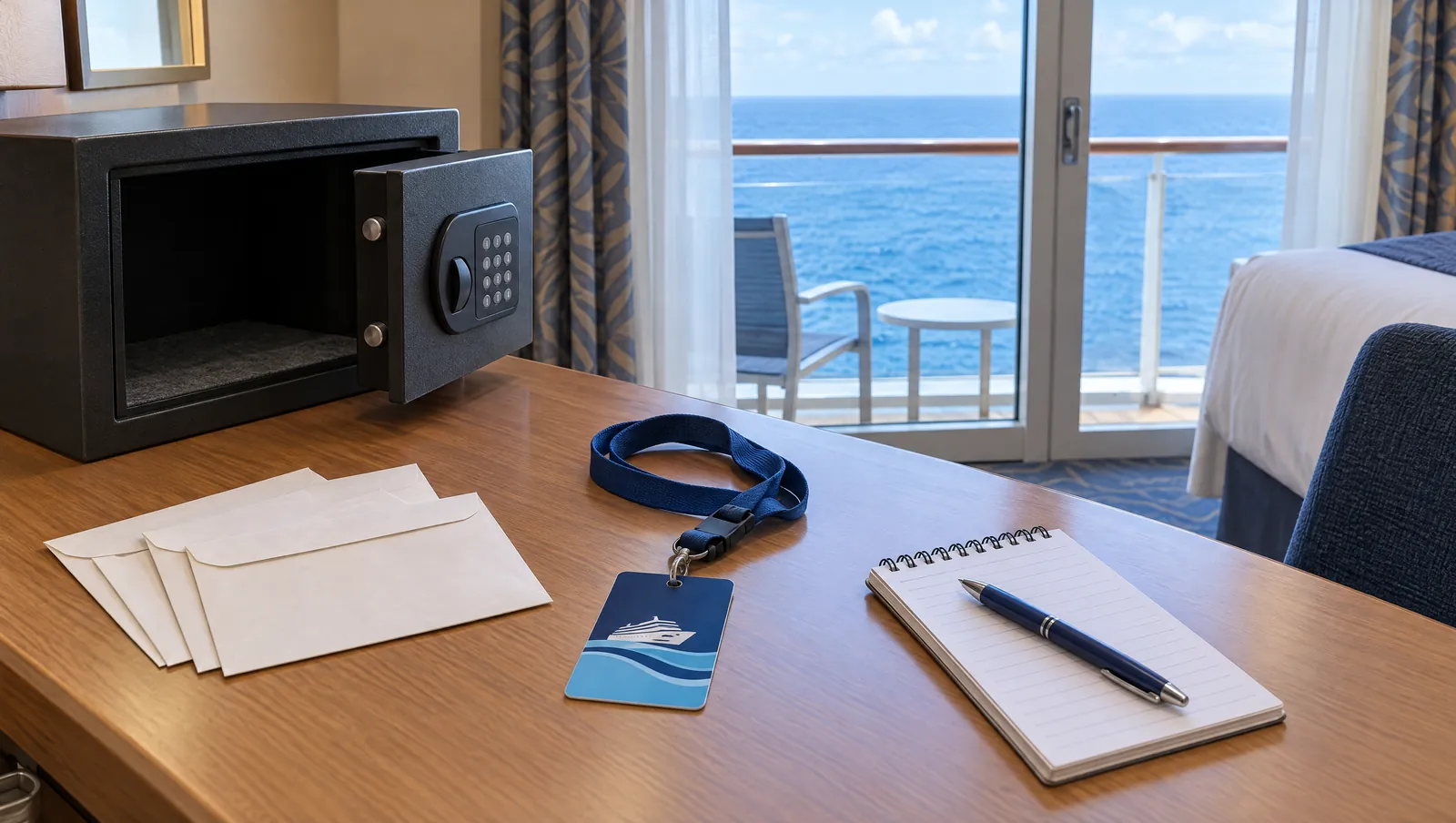
Decide exactly how much you will gamble before you leave home, and only bring money you are fully prepared to lose. Divide it by sea days, split each day into short sessions, and stop when a session's money is gone. My own rule: I never bring more than the cruise would have cost me.
The one rule
Gamble only with money you are fully prepared to lose. Not money for bills, not savings, not money you will need to explain. The National Council on Problem Gambling puts it just as plainly: set time and money limits and stick to them, and never gamble with money meant for rent, bills or savings.
My personal version: I never bring more than the cruise would have cost me. If I lose it all, I paid less than the fare. If I win, it is a bonus.
Set it up before you leave home
- Pick your number. Write it down. Tell your spouse or a friend.
- Divide it by sea days. Ship casinos are usually closed in port, so most play happens at sea. A $1,000 budget on a cruise with four sea days is $250 a day.
- Split each day into sessions. For example, two sessions of $125. When a session's money is gone, that session is over.
- Decide your win rule now. For example: from any single win over $200, half goes to the cabin safe straight away and stays there.
- Bring it as cash, one envelope per day.
What my budget actually buys
I bring $1,000. On Royal Caribbean and Celebrity I usually finish a sailing with 1,500 to 2,500 casino points. At $5 of play per point, that means I run $7,500 to $12,500 through the machines on my original $1,000 plus whatever I win along the way. That play is what brings the offers home, sometimes five or more a week for close to a year.
I usually sail alone in a double room, and at internet prices one of those cruises runs me about $3,700. Some cruises I come home with extra money, some I lose a couple of hundred, some I come home with exactly what I took. Because I never bring more than the cruise would have cost, I come out ahead either way.
My tier-match cruise: a big points chase that stayed on budget
One cruise came to me through a tier match, and I wanted that line to keep sending me offers, so I went point hunting. My husband came with me. We brought $1,000 in cash, and we each had $200 in onboard credit. I cycled that $1,000 through the machines, playing my wins back in, and earned more than 10,000 points.
- The cash: I came home with $400 of the $1,000, so the casino kept $600.
- My husband’s $200 onboard credit: he lost it at the blackjack table.
- My $200 onboard credit: $175 bought a Lotus Spa package for the two of us for our anniversary, and I played the last $25.
All told, the casino got $825 of our cash and credit, and I came home with more than 10,000 points, $400 in my pocket and a spa day with my husband. A points chase is exactly when budgets break. What kept this one on track was deciding the money at home: the cash, and what each of us would do with our onboard credit. That is why this page comes before any strategy.
Why good people blow their budget
Almost everyone who goes over meant not to. The casino is built to make stopping hard. Knowing how it works is your best protection.
- Your brain loves not knowing. The reward system fires while you wait to see what happens, not just when you win. A slot machine delivers that every few seconds.
- The “house money” trap. An early win feels free, so you bet it loosely. It is your money now.
- Chasing losses. “I'll just win back what I lost” is the fastest way through a budget.
- Losses dressed up as wins. The machine plays music when you win $1.20 on a $2.50 spin. You just lost $1.30.
- Near misses. Two jackpot symbols and the third just above the line feels like “almost.” It is simply a loss.
- The ship card. Charging play to your room does not feel like spending real money. It is.
- Free drinks. Judgment drops as the drinks go up.
- “Just 300 more points.” Chasing a certificate is the trap that got me.
There is more on these in casino myths and mind traps.
How to protect yourself
- Leave your cards in the safe. Bring only the day's cash. Ask the casino whether you can block or cap casino charges on your ship card.
- Never use the casino cash machine or a cash advance. If you are reaching for one, your budget is already gone.
- Use a 24-hour rule. You may never raise your budget on the same day you want to.
- Set a phone alarm for each session.
- Give your reserve money to your travel partner, and agree ahead of time they will not hand it over mid-cruise.
- Walk away on a schedule, not a feeling. Stop when the session ends, win or lose.
My casino rules card
Fill this in at home and keep it in your wallet behind your ship card.
My Casino Rules
Gambling should stay fun. If it isn't, free and confidential help is there 24/7: call or text 1-800-MY-RESET (1-800-697-3738) or visit 1800myreset.org. Playing safe →
← Casino & Comps overviewNext: Slots, video poker and points →
Where these facts come from
- National Council on Problem Gambling, responsible gambling guidelines (5 Feb 2026) — checked 20 October 2026
- New York State Gaming Commission, Responsible gaming — checked 20 October 2026
- Royal Caribbean, Club Royale earning rates — checked 20 October 2026
If stairs, gangways and tenders are a problem, there is a whole section of this site for you. Sails Anyway covers accessible and limited-mobility cruising properly instead of squeezing it into a paragraph: what each pier actually asks of you, which tender ports are a problem and why, the special-needs forms and the deadlines that catch people out, and how to choose a cabin you can move around in.
About the "I" on this page. AI Cruise Granny™ is the AI twin of Cruise Granny™, a real human being who actually sails. Every experience written here in the first person is hers. The AI twin is what writes it up, checks the facts against official sources and keeps it current. We tell you that openly on every page, because you should know who is talking to you. More about how this works.